
Small Patio Paver Patterns: 4 Clean Layout Ideas
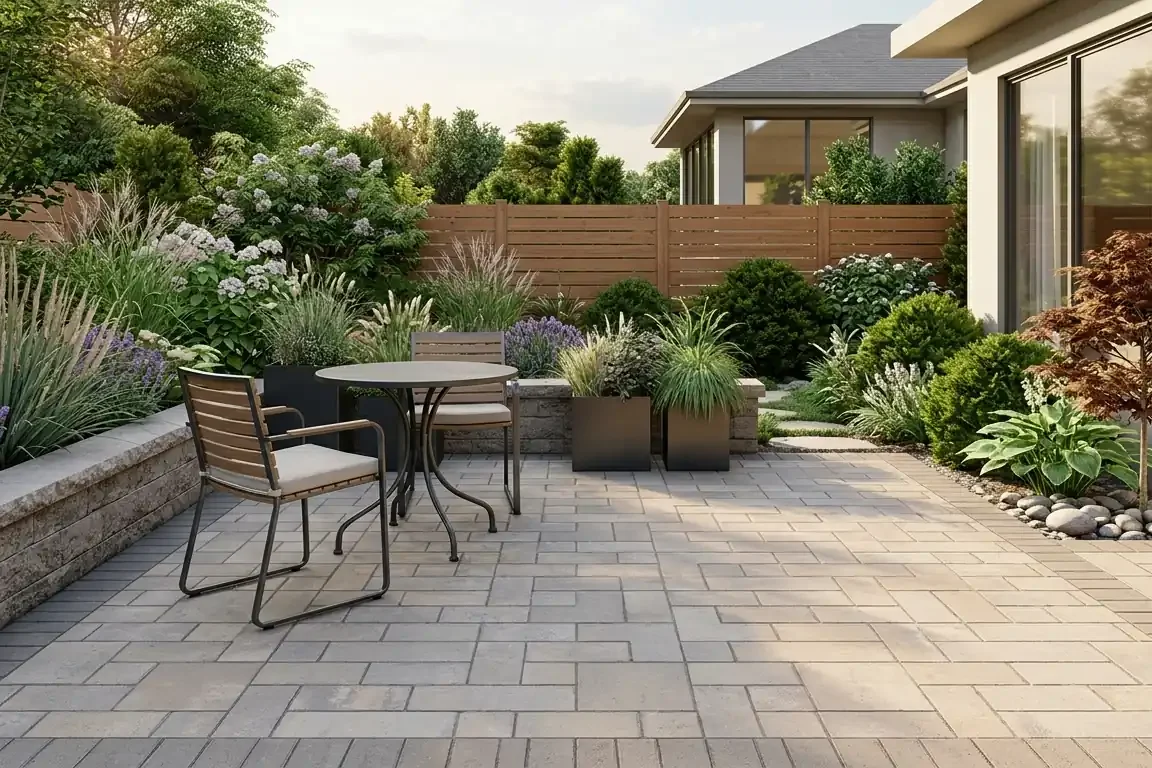
Selecting the right small patio paver patterns can dramatically alter how spacious, balanced, and functional a compact outdoor terrace feels. Rather than overwhelming a modest backyard with chaotic multi-size stone blends, sticking to clean geometric arrangements maximizes usable ground area while minimizing awkward diagonal cuts along the edges.
Comparing Patio Paver Layout Options
Before ordering pallets, evaluating your small patio paver pattern layout helps you match stone proportions with the shape of your yard. For compact courtyards and small outdoor entertaining zones, four distinct patterns provide structured visual appeal without clutter:
1. Modern Stack Bond (Grid Layout)
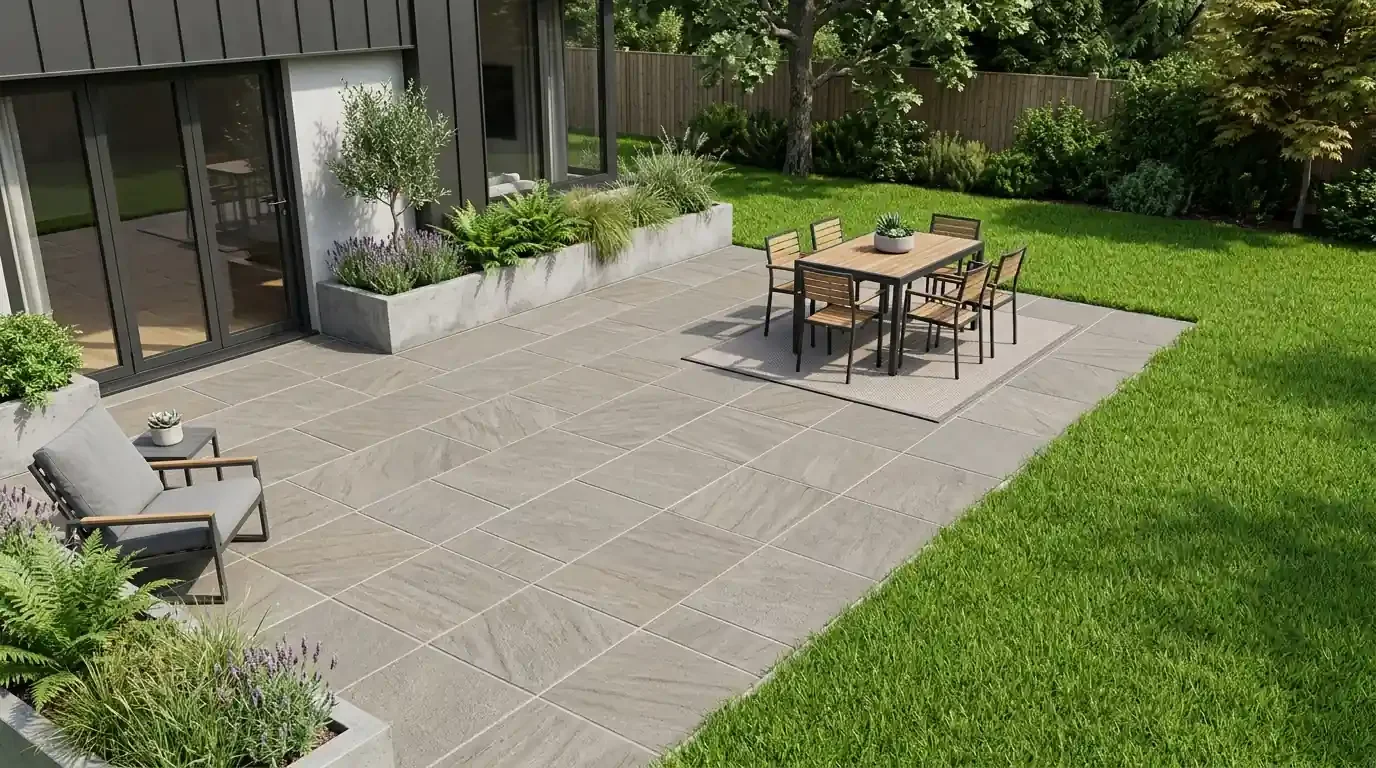
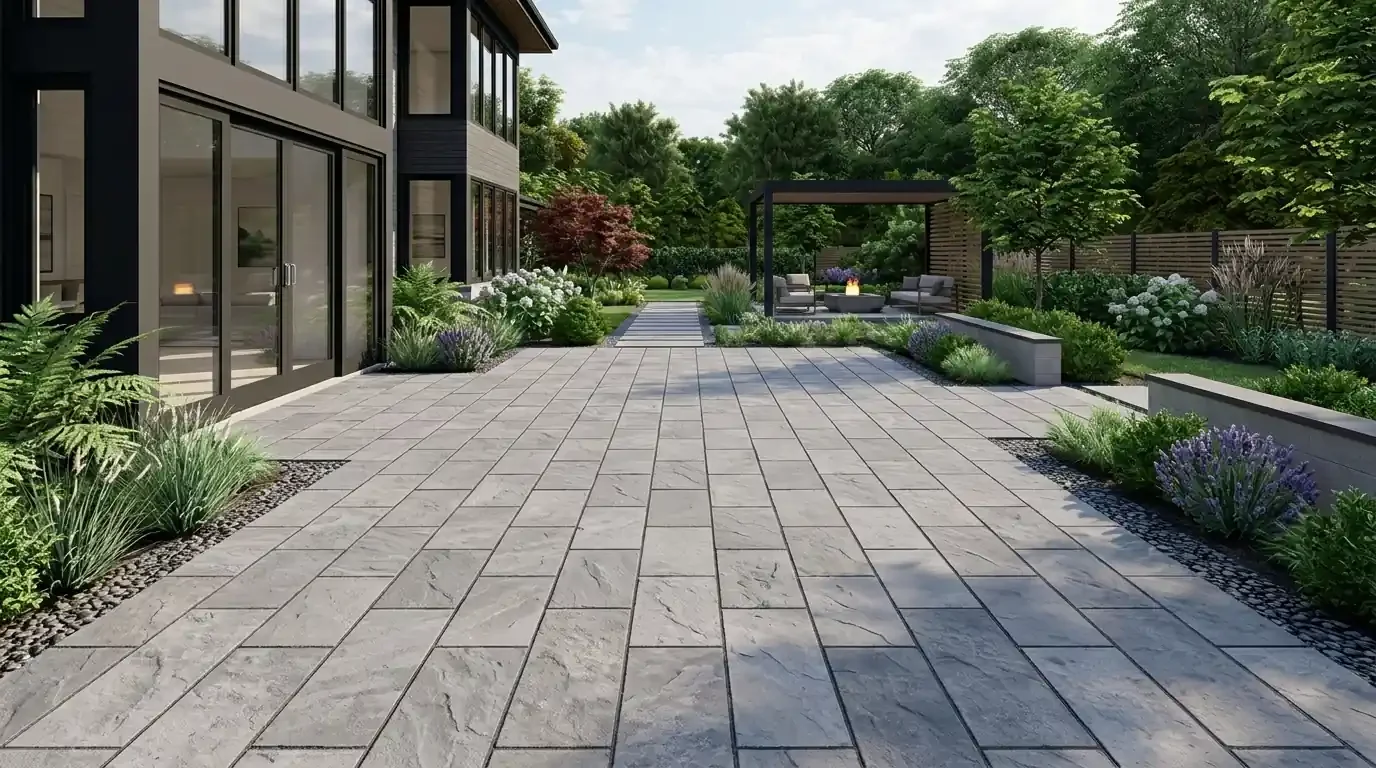
In a stack bond arrangement, square or rectangular pavers align in continuous, unbroken horizontal and vertical joint lines. This minimalist grid creates a clean, contemporary aesthetic that visually organizes tight outdoor spaces and pairs seamlessly with modern architectural lines.
Stack bond represents one of the most straightforward, easy small patio paver patterns to plan because there are no staggered joint offsets to calculate. However, because joint lines run continuously in both directions, laying each unit straight requires meticulous line stringing to prevent wavy seams.
2. Classic Running Bond with Half-Lap Offset
A running bond layout offsets each consecutive row of pavers by exactly 50% (half of the paver length). This staggered arrangement breaks up long joint lines across one axis, providing greater interlock and visual movement across the terrace.
Running bond is exceptionally versatile for small courtyards because orienting the long joints across the narrower dimension of the patio visually widens the area. In rectangular footprints, running bond also simplifies edge trimming, as cut half-pavers from one end of a row can often start the next.
3. 90-Degree Herringbone Interlocking Pattern
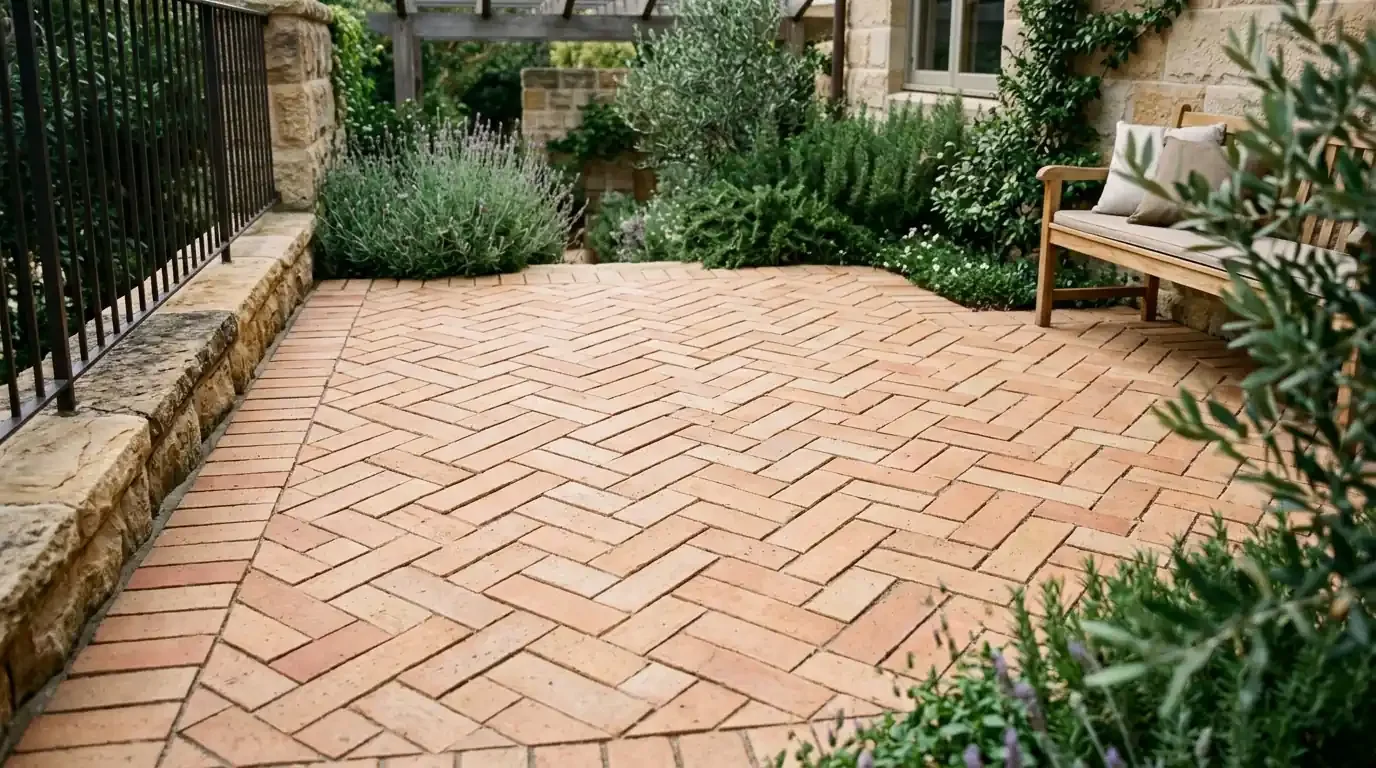
The 90-degree herringbone pattern places rectangular pavers in perpendicular, alternating pairs to create a classic zigzag field. Because forces distribute evenly across the interlocking stones, herringbone resists shifting under furniture movement and foot traffic.
Modular Proportion Requirement: A true herringbone pattern can only be executed if your rectangular pavers have an exact modular aspect ratio where the length is an exact multiple of the width (such as 2:1, meaning 200×100 mm or 400×200 mm). If pavers have non-modular dimensions, joints will not align without continuous custom trimming.
4. Single-Course Border Frames (Soldier and Sailor Courses)
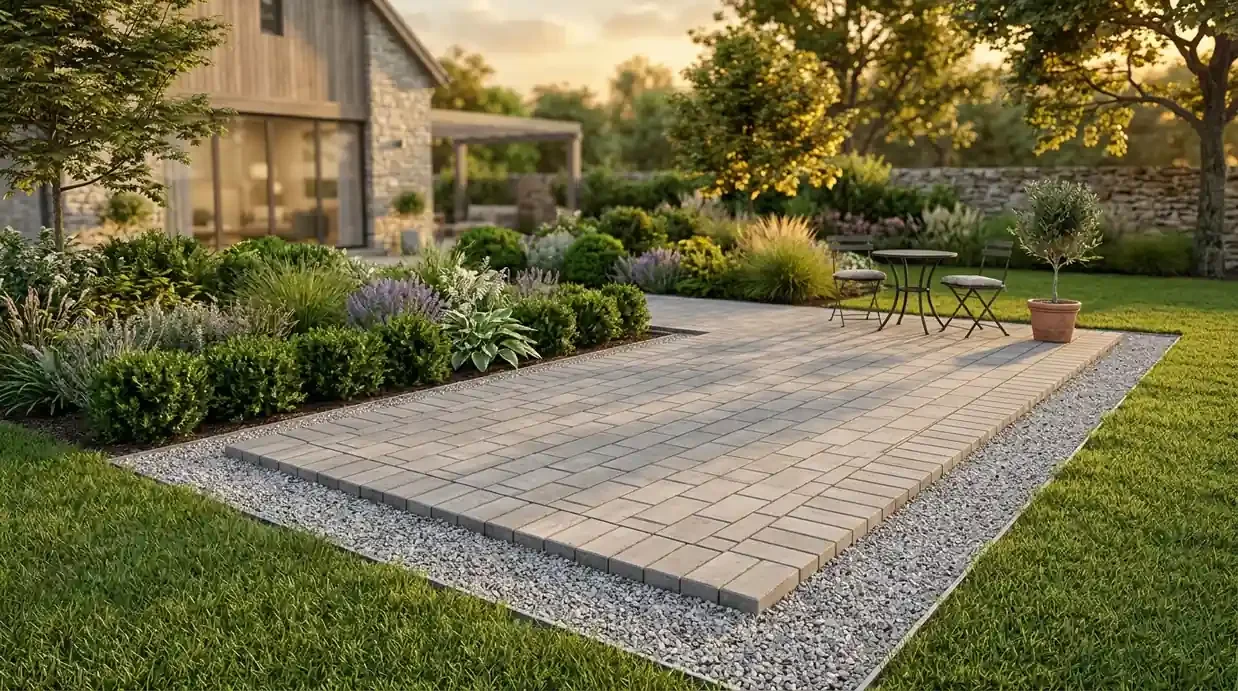
Adding a single-course border around the perimeter frames the interior paver field like a picture frame, giving small patios a polished, finished architectural edge. Perimeter borders are commonly installed in two styles:
- Soldier Course: Pavers are laid standing upright or oriented perpendicular to the patio edge, forming a bold outer frame that clearly delineates patio boundaries from surrounding lawn or garden beds.
- Sailor Course: Pavers are laid lengthwise parallel to the perimeter edge, creating a subtler, continuous ribbon boundary.
Beyond aesthetics, a single-course border serves a functional role by containing field cuts cleanly within the perimeter, preventing raw saw cuts from showing along the visible lawn edge.
How to Calculate Paver Quantities on a Small Patio
Understanding small patio paver pattern spacing and coverage begins with simple modular arithmetic. In small rectilinear areas, choosing modular paver dimensions that divide evenly into your patio footprint eliminates fractional cutting altogether.
Consider an exact modular layout example on a 2×2 m ($4\text{ m}^2$) small garden terrace using square pavers with a 0.5×0.5 m (500×500 mm) module size:
- Row Layout: A 2-meter span accommodates exactly 4 pavers along each row ($2\text{ m} ÷ 0.5\text{ m} = 4\text{ pavers}$).
- Column Layout: A 2-meter depth accommodates exactly 4 pavers along each column ($2\text{ m} ÷ 0.5\text{ m} = 4\text{ pavers}$).
- Total Paver Count: 4 rows × 4 columns = exactly 16 full pavers, covering the entire $4\text{ m}^2$ area with zero wasted offcuts.
Scope Note: Complex circular paver kits and freeform random multi-size stone packages require specialized radial cuts and irregular jointing that are outside the scope of compact grid planning. For small patios, modular square and 2:1 rectangular formats provide the cleanest installation and most predictable material counts.
Plan Your Patio Layout Online
Before excavating or ordering materials, calculate your surface requirements and preview layouts with our free tools:
- Paver Calculator: Calculate total paver counts, surface square footage, and pallet estimates for your specific terrace dimensions.
More ideas for your project
All ideas